


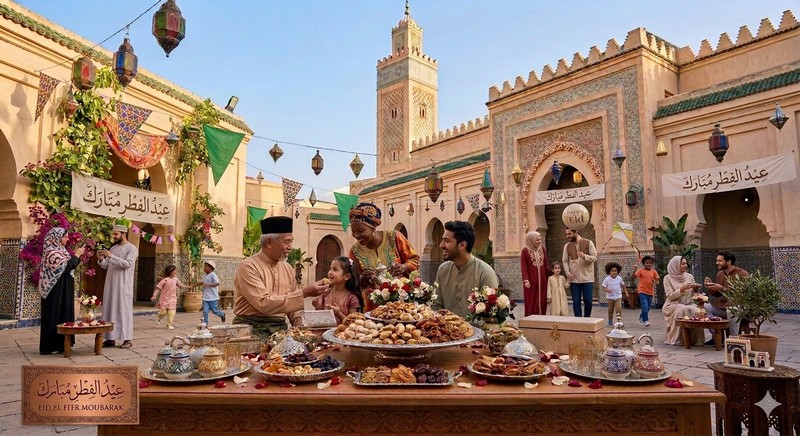
This year, Muslims are celebrating Eid el-Fitr, also called Eid es-Seghir, on March 19 or 20, 2026. It is the great festival of forgiveness, which crowns the end of Ramadan. It takes place on the first day of Shawwal, the 10th month of the Muslim calendar, lunar cycle.
Eid is the celebration of forgiveness and conviviality. Eid is an opportunity to share joy as a community, beg forgiveness and express wishes for everything that comforts and promotes well-being.
The meaning of Eid
For the faster, it is the day of reward. The reward here takes on both a human meaning, by freeing oneself from deprivation, and a spiritual one by appreciating the merit and the effect of spiritual immersion.
It is the festival of forgiveness, where everyone is required to forget their resentment and reconnect with others. It is remembered on this day, more than ever, that faith cannot go hand in hand with resentment and hatred and that forgiveness remains an act of faith and a path to salvation.
It is also the celebration of sharing and conviviality.
The feast of Eid
A few days before Eid, families prepare for the celebration: beautifying homes, baking all kinds of cakes and buying new clothes for the children. The preparation rituals take on a festive and unique taste.
Two essential religious rituals mark the celebration of Eid: zakat el-fitr or the small alms and salat el-Eid or the Eid prayer. The first is dedicated to sharing and the second to faith and forgiveness.
Zakat el-fitr is an alms that every believer must pay to the needy, during the last three days and cannot last longer than the hour preceding prayer, on the day of Eid itself. It is the head of the family who must pay it for each head, in foodstuffs, for a quantity of 3 kg per head, or its equivalent in money, determined each year by the religious authority. This ritual dedicated to sharing allows the needy to acquire their needs and thus celebrate the festival with dignity.
Salat el-Aïd or the Eid prayer, consists of a collective prayer which takes place in an open-air prayer area, or even inside mosques. The famous Eid sermon is an opportunity to celebrate faith and recall the virtues of sharing and forgiveness. The prayer ends with hugs, exchanges of vows and words of forgiveness.
As soon as the prayer is over, everyone returns to their respective homes to celebrate the Eid festival with their families. Everyone puts on their beautiful clothes and gathers around a table decorated with the festive flavor of Eid, garnished with cakes of all kinds, especially almond cakes.
After the exchange of wishes between family members, and the taking of family photos, the ritual of group visits begins, with relatives, elders and sick people, to exchange wishes and joy. Children are always attentive to the amount of money that friends and parents offer them on this festive day.
While adults exchange greetings, children wander from one corner of the village or neighborhood to another, to experience the joy of Eid as a group, demonstrate their beautiful clothes and spend the money they receive as gifts during Eid in toy and candy stores.
The party ends at sunset, and everyone returns to their homes, in joy and good humor.
Muslim communities in Quebec do not lack imagination to reinvent the festive conditions of Eid and to live it fully in joy and conviviality. It is customary to rent, by district or city depending on the size, spaces in large hotels and reception rooms to collectively celebrate the Eid prayer and exchange wishes, joys and cakes. And it is only at the weekend following Eid that they meet again in large hotel or reception rooms, to celebrate with families throughout the day, the joy of Eid. In these places rented for the day, children have a play area where inflatable games of all kinds are arranged, and everyone benefits from the services offered by the various food and entertainment kiosks, such as the henna kiosk, the clown, etc.
People remember the precious memories of Eid, a day of faith, joy, peace, sharing and conviviality.
But, in these moments of a troubled world, Eid is also a unique occasion, which places human beings before their vulnerability, called to think of those who constantly experience deprivation and its ordeal, because of wars, exclusion, poverty, famines, exiles, etc.
Eid, in the context of crises, offers a valuable opportunity to meditate and see, not only how to overcome the crisis, but also how to remedy one’s way of life, stop harmful acts caused to others, and show more solidarity towards the needy and the most vulnerable, among people suffering from loneliness, deprivation and loss of autonomy.
Dr Brahim Benyoucef