


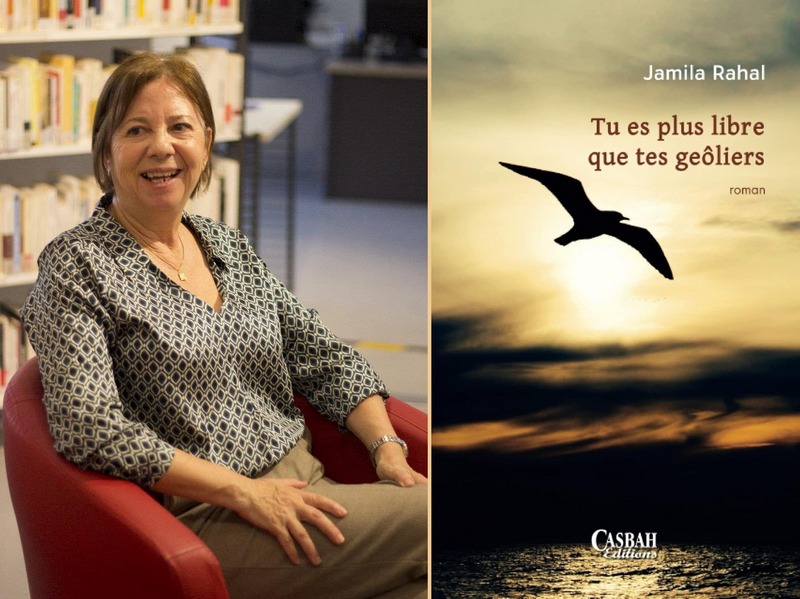
Born in 1958 in Berkane, a small town in eastern Morocco, Jamila Rahal had the privilege of growing up in a family of scholars. Between a father passionate about History and a mother lulled by the culture of the Tlemcenian region, songs, poems, adages, Jamila remains attentive to this sensitivity. She often uses hearing to show the importance of listening in an environment where orality accompanies the sense of memory. Passionate about reading, Jamila has worked in several book sectors, from organizing events to publishing and writing for young people.
The initiative: From the beginning of the novel “You are freer than your jailers”, a quote from the Arab chiefs who address Lamoricière is highlighted, can you explain the reasons for this choice?
Jamila Rahal: This metaphor of the wave barely disturbed by the wing of the bird, beyond its poetic character which already touches me as such, suggests the ephemeral character of the human passage even when it believes itself to be powerful and decisive. Any domination, however brutal or assured it may be, is part of a temporality that goes beyond it and ends up erasing it. Thus, those who claim to appropriate a land or a destiny come up against the inflexible reality of the long term which puts conquests into perspective and dissolves certainties. More simply, it shows the vanity of men’s pretensions in the face of the permanence of the world.
In the narration there is an alternation between lived stories and History which has marked, like p. 65: “The following summer was at its peak when, in the middle of the month of Ramadan, the First World War was declared. On August 4, 1914, the tone was set on Algerian soil by the bombardment of German cruisers, the Breslau and the Goeben, on Bône and Philippeville. Can you give details about the impact of the First World War on daily life?
In Algeria, the First World War imposed on the colonized a war that was not theirs, while exposing the fractures of a deeply unequal system. From the bombings of Skikda and Annaba, it became a tangible reality whose most lasting imprint can be read in the forcibly mobilized bodies, the dislocated families, the countless bereavements, the traumas, the requisitions, the famine, the repression. Daily life falls into a continuous ordeal, a diffuse and persistent violence which imposes itself at every moment and strongly marks memories.
On page 370, you write: “The entire press was in fact unanimous in condemning the nationalists in general, and the PPA in particular. The socialists blamed them for having “sullied the great hour of the victory of democracies” and asserted that the ruling elites who organized and triggered the movement had no political maturity.” Can you explain the context of this idea?
In the aftermath of the massacres in Sétif, Guelma and Kherrata, it is not only a question of repressing, but of legitimizing the repression. A large part of the press and French political forces, including on the left, are adopting a discourse that reverses responsibilities. Indeed, the nationalists are accused of having disturbed order, even though they were only demanding promised rights. The goal was to disqualify these demands by presenting them as premature or irresponsible, while obscuring the extreme violence of the repression. Finally, it reveals a major contradiction. Celebrate the victory of democracies while refusing these principles to the colonized.
Do you think that History is an anchor point that allows us to weave little stories or is it not a trigger for everything that has been kept quiet for a long time?
I would like to point out above all that a historical novel is not a history book. However, the two points of view are inseparable. Great History constitutes a foundation and an inexhaustible source of inspiration. But it is the intimate stories, the experiences lived in anonymity, which give it flesh and truth. They reveal what official accounts cannot capture or explore, namely the human, sensitive and often silent part of History.
Interview conducted by Lamia Bereksi Meddahi