


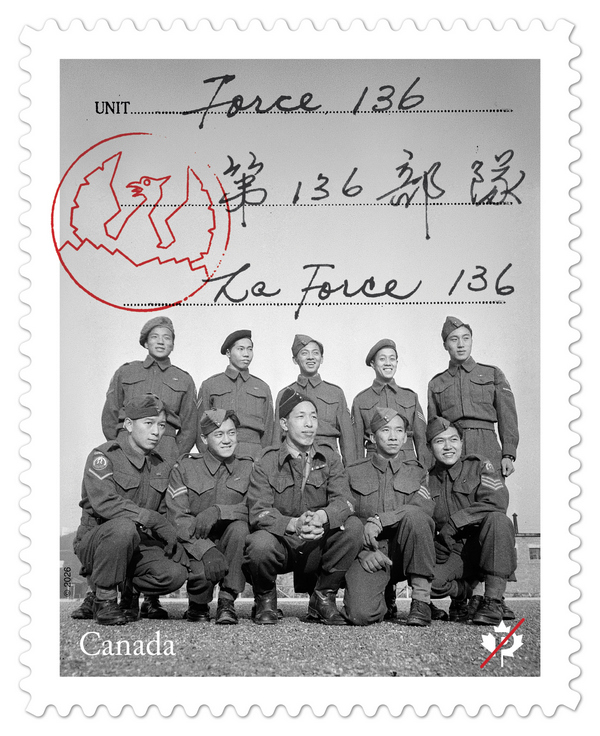
Despite the racial discrimination of the time, Chinese-Canadians volunteered to participate in dangerous secret missions behind Japanese lines during the Second World War.
Today, Canada Post unveiled its new Remembrance Day stamp, which honors Chinese Canadians who enlisted in Force 136 and participated in Allied covert operations in Asia during the Second World War. Despite the racial discrimination they faced in Canada, approximately 150 Chinese-Canadians signed up to serve behind Japanese lines. Their service contributed to the Allied war effort and helped break down racial barriers in Canada. The stamp was unveiled today at an event at the Chinese Canadian Museum in Vancouver in the presence of relatives of Chinese-Canadian soldiers serving in Force 136. Demonstration of patriotism At the start of the Second World War, Canadians of Chinese origin were initially refused enlistment due to racial discrimination. The situation changed in 1944, when Allied strategists sought Chinese-Canadians with the language skills and the ability to blend in with the population to carry out covert operations in Asia occupied by Japan. About 150 of them were recruited into Force 136. In the British Special Operations Directorate or the Australian Services Reconnaissance Department, they carried out dangerous missions behind enemy lines. They undergo rigorous training, in Canada and abroad: espionage, guerrilla tactics, parachuting, radio telegraphy and survival in the jungle. Their mission is to gather intelligence, support local resistance networks and carry out sabotage operations. In addition to the constant threat of capture, torture and death, they had to contend with extreme heat, insects and disease. For the Chinese-Canadian community, military service represented more than support for the war effort. At the time, Chinese-Canadians were deprived of the right to vote and could not practice their profession. Additionally, immigration from China is heavily restricted by the Chinese Immigration Act of 1923, commonly known as the Chinese Exclusion Act, relegating this population to second-tier status. Despite everything, enlisting was seen as a way of demonstrating Canadian patriotism and demanding change. “They wanted to prove that they belonged to Canada and believed that the best way to do that was to fight for their country, even if they were treated as second-rate people,” explains Catherine Clement, community historian, author and curator. While some soldiers are deployed abroad, including in Malaysia or Borneo, others are still in training at the end of the conflict. By the end of the Second World War, more than 600 Chinese Canadians had served in all three branches of the Canadian military. Their service was part of a broader movement for change in the country. As a result, the Chinese Immigration Act of 1923 was repealed two years after the end of the Second World War, in 1947, and the Chinese-Canadian population obtained full citizenship and the right to vote.