


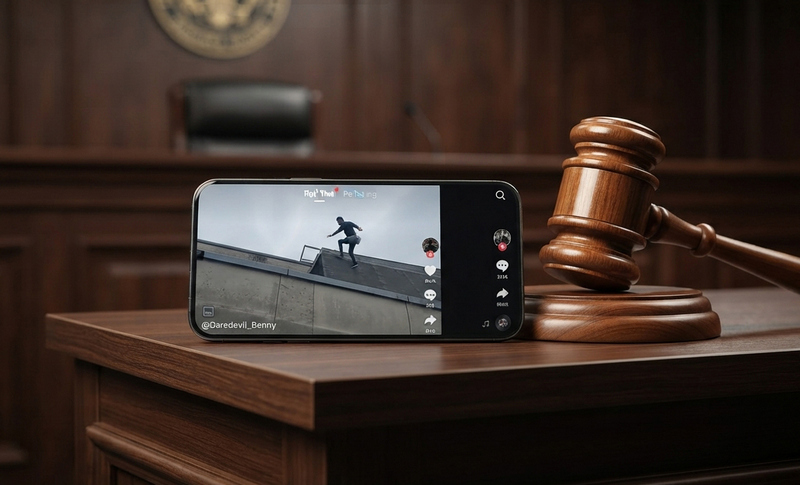
The proliferation of extreme challenges on TikTok no longer represents just a health crisis in hospital emergency rooms, it has become a major public safety issue. To achieve virtual notoriety, many adolescents and young adults cross the boundaries of legality, unaware that the consequences of their videos lasting a few seconds can impact their legal records in perpetuity.
The Tide Pod challenge
One of the most physically devastating challenges remains the Tide Pod challenge, which pushes young people to chew or ingest detergent capsules. Beyond serious chemical burns to the esophagus and stomach, there is a dark legal aspect to this challenge: inciting others or minors to consume a toxic substance can be classified as inciting self-infliction of bodily harm, a criminal offense subject to prosecution.
The Blackout challenge
The Black-out challenge (voluntary asphyxiation) as well as its variant consisting of crossing a busy street blindfolded, expose participants to irreversible brain damage or death. Legally, if a young person films or encourages a friend to take on this challenge and the latter is injured or dies, the facilitator can be arrested and charged with criminal negligence causing death or aiding suicide, crimes punishable by life imprisonment under the Criminal Code.
Coordinated intimidation
In the register of group harassment, the challenge of staring at and surrounding passers-by wearing specific shoes relies on coordinated intimidation. Filming a person without their knowledge while cornering them in a public space constitutes an offense of criminal harassment and assault. In addition, broadcasting the video without consent violates image rights and exposes the authors to heavy civil action for damages for damage to reputation.
Motorcycles inside schools
Boldness has also crossed the doors of educational establishments with the challenge of introducing motorcycles inside schools. Driving at high speed in the corridors endangers the lives of students and staff. Police forces no longer hesitate to arrest drivers and their accomplices on charges of dangerous driving, break and enter and mischief over $5,000. These acts result in permanent expulsion from the school and immediate seizure of the vehicle.
The Lug Nut Challenge
The challenge of unscrewing vehicle wheel nuts (often called the Lug Nut Challenge on social media) is a highly criminal and deadly trend that has emerged on platforms like TikTok. The concept involves spotting a randomly parked vehicle, using a suitable wrench to partially or completely unscrew the wheel nuts, then remotely filming the car restarting to capture the moment the wheel comes off. This challenge is not a hoax, it is a serious criminal act. Under the Canadian Criminal Code and the YCJA (for ages 12 to 17), young people who participate in this challenge face charges of mischief causing real danger to the lives of others (punishable by life imprisonment), charges of criminal negligence or assault with a weapon (the car or detached wheel being considered the weapon). Likewise, if a fatal accident occurs, prosecution for manslaughter or criminal negligence causing death, with a real possibility of being tried as an adult, could be brought.
The Superman dance
Finally, the Superman dance, which involves climbing onto the roof of a moving car, combines the risk of fatal head trauma with severe legal sanctions. The driver of the vehicle faces charges of dangerous driving and immediate withdrawal of his license, while the stuntman may receive heavy fines under the Highway Safety Code for endangering the safety of others.
Why have we got to this point and what are the solutions?
The adolescent brain handles impulsivity poorly, and TikTok’s recommendation algorithm acts as a catalyst by rewarding shocking content with instant visibility. Social networks bear undeniable responsibility in this escalation. During adolescence, the prefrontal cortex (the area responsible for judgment, planning and controlling impulsivity) is still developing. Conversely, the limbic system (the center of emotions and rewards) is firing on all cylinders. When a young person sees a video rack up millions of views, their brain immediately associates risk-taking with immense social reward. The need for peer validation and the fear of being excluded then override the instinct for self-preservation.
Faced with this, the answer is now legal. School principals apply a zero tolerance policy by collaborating with police officers. The courts point out that the excuse of “it was just for a TikTok” does not hold up in court.
The YCJPA shield: very real consequences
In Canada, young people aged 12 to 17 who commit these offenses are governed by the Youth Criminal Justice Act (YCJA). Contrary to a persistent misconception among young people, the YCJPA does not mean an absence of consequences. Although the law favors rehabilitation and extrajudicial measures (such as community service or letters of apology) for minor infractions, it is very severe when it comes to high-risk behavior displayed on the web.
For serious offenses such as criminal negligence causing death or dangerous driving (motorcycle in school), a teenager can receive sentences of placement in custody (juvenile prison). In addition, for the most violent crimes committed by young people aged 14 and over, the court can impose a sentence applicable to adults.
Finally, the existence of an adolescent’s record massively restricts future freedom. Even if it is confidential and subject to closed periods, this file can block access to student jobs (childcare, day camps), prevent admission to certain university programs and result in a strict ban on traveling abroad, particularly to the United States, where the simple admission of an offense can lead to refusal of access to the borders. Wasting your future for a handful of likes has never been so expensive.
Martine Dallaire, B.B.A.