


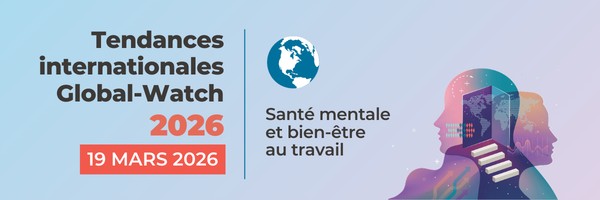
The Global-Watch center of expertise unveils 2026 trends in mental health and well-being at work during a virtual international event on March 19
Nearly 1 in 2 workers have hidden their mental health status at work in the last year according to a Léger survey commissioned by the Global-Watch center of expertise in February 2026. These results, international trends in mental health and well-being at work as well as promising practices observed in companies will be presented during a free virtual event on March 19, to which nearly 1,800 people have already registered.
According to this survey conducted by Léger among 601 Quebec workers: • Nearly 1 in 2 workers have hidden their mental health state at work in the last year and almost a quarter of them (24%) say they do it systematically with their employer or colleagues, even when they are experiencing stress, anxiety or exhaustion.
A widespread phenomenon linked to precariousness and stigma
The results highlight that concealment particularly affects: • young workers, almost a quarter of whom systematically conceal their difficulties. • women, who are more numerous (50%) than men (38%) to conceal their state of mental health. This result could be explained by the fact that women, like young people, are populations more prone to precarious situations, which increases their feeling of vulnerability and leads them more to hide their state of mental health to protect themselves*.
“This data confirms the need for organizations to foster a climate of trust; a large proportion of workers are still hesitant to show themselves vulnerable in terms of mental health. This restraint can have significant consequences, both for individual health and for organizational performance,” explains Marie-Claude Pelletier, president and founder of the Global-Watch center of expertise.
Consequences for individuals and organizations
Concealing the state of mental health can lead to several risks for organizations, including: • Limiting access to necessary resources, support and accommodation • Maintaining or worsening the mental health state of the people concerned, sometimes leading to disability * We can guess that this increase in psychological distress can have negative consequences on people at work, and affect their performance and their relationships with others, thus impacting the work climate in general.
Renowned experts to decipher international trends in mental health and well-being at work
In addition to the concealment of mental health issues, the event will address: • the deterioration of the work climate and the growing disengagement of employees, particularly among managers • the growing importance of equipping employees with financial health • the training and reskilling needs generated by artificial intelligence • the fragility of organizational achievements in equity, diversity and inclusion in the current political context • the adaptation of policies and actions linked to psychosocial risks (RPS), in particular need to better equip managers to deal with the issues of mental health, work overload, and incivility • recent data on the gains linked to investments in mental health at work Participants will be able to: • Explore current trends in organizational practices and scientific advances • Discover promising practices observed in companies • Anticipate emerging and future issues • Benefit from international perspectives thanks to the collaboration of academic experts and international practitioners
After an opening word from Michelle Lambías Meunier, of the Conseil du Patronat du Québec (CPQ) and Laurence Breton-Kueny, of the National Association of HR Directors in France, the trends will be presented by Marie-Claude Pelletier, of the Global-Watch Center of Expertise and then completed on a scientific level by Pre France St-Hilaire, of the University of Sherbrooke. The event, which represents 3 hours of continuing education, of which 2.5 recognized by the Order of CRHA and the Chamber of Financial Security, will bring together leading experts and practitioners, including Lydie Breton from Sodexo in France, Alexandre Hubert from Énergir, Christian Racine from the Gold Fields mining company, Lucie Lecoeur from the Normandy Region. The event is supported by several leading organizations: the Quebec Employers’ Council, the Commission on Standards, Equity, Health and Safety at Work (CNESST), the National Association of HR Directors in France (ANDRH) in France, Groupe Biron, Gold Fields, The Sinneave Family Foundation, the School of Management of the University of Sherbrooke, as well as several large Quebec companies.
The event takes place online on March 19 from 9 a.m. to noon (UTC-5).
* Sources Baldwin, M. L. (2021). The three Cs of disclosing serious mental illness at work: Control, conditions, costs. Psychiatric Services, 72(3), 344-346.
Barth, S. E., & Wessel, J. L. (2022). Mental illness disclosure in organizations: Defining and predicting (un) supportive responses. Journal of Business and Psychology, 37(2), 407-428.
Brouwers, E. P. M., Joosen, M. C. W., Van Zelst, C., & Van Weeghel, J. (2020). To disclose or not to disclose: a multi-stakeholder focus group study on mental health issues in the work environment. Journal of occupational rehabilitation, 30(1), 84-92.
Canada Life. (2024). The cost of inaction: Why should companies prioritize mental health in disability management?
Dewa CS, van Weeghel J, Joosen MCW, Gronholm PC and Brouwers EPM (2021) Workers’ Decisions to Disclose a Mental Health Issue to Managers and the Consequences. Forehead. Psychiatry 12:631032. doi: 10.3389/fpsyt.2021.631032
Gnainsky, M., Roe, D., Negri-Schwartz, O., Cohen-Chazani, Y., Lavidor, M., & Hasson-Ohayon, I. (2025). To disclose or not to disclose: A systematic review of factors associated with disclosure and concealment of mental illnesses. Clinical Psychology Review, 102660.
Richard, C., Corbière, M., Fiset-Renaud, H., Caiada, M., Lamontagne, J., Diotte, F., … & Lecomte, T. (2025). Disclosure impact of mental health conditions in tSun Life. (2024). Women’s health: emerging trends and effective supports (Health Objective Report)he workplace: A scoping review and a thematic analysis. Journal of occupational Rehabilitation, 1-36.
Volkov, I., Sheppard, D. M., Kirk-Brown, A., & Van Dijk, P. (2025). Workplace Outcomes After Mental Health Disclosure: The Critical Influence of Supervisor Reactions. Journal of Occupational Rehabilitation, 1-12.
ABOUT GLOBAL-WATCHThe Global-Watch Center of Expertise’s mission is to improve mental health and well-being at work around the world in a sustainable way. With its products and services, Global-Watch supports HR/OHS teams in integrating good practices promoting mental health, quality of life at work (QVT) and well-being at work. Its work consists of popularizing scientific knowledge, developing concrete tools for action in business and nurturing an international community of business practitioners, while offering strategic support to HR/SST teams. Of Canadian origin, Global-Watch now reaches with its member employers nearly a million and a half employees in around fifty countries. For more information, click here.
ABOUT MARIE-CLAUDE PELLETIERA reference in the field, Marie-Claude Pelletier has specialized for 25 years in mental health, well-being and performance at work, in Canada and Europe. She has developed and managed several major projects and companies in the field and is regularly featured as a speaker and expert at major meetings on the subject in Canada and Europe. In 2018, it launched the Global-Watch center of expertise with the mission to improve mental health and well-being at work around the world in a sustainable way.