


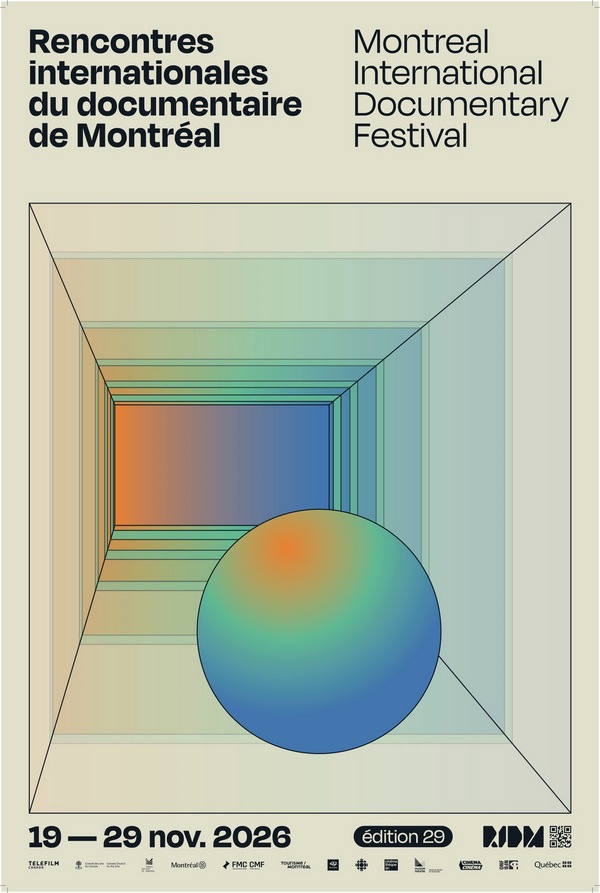
The Montreal International Documentary Meetings (RIDM) are proud to unveil the programming for their 29th edition, which will take place from November 19 to 29, 2026. Bringing together this year 127 films from 54 countries, including 25 world premieres, 19 North American premieres, 22 Canadian premieres and 28 Quebec premieres, the festival offers a rich and daring panorama of documentary cinema, where the intersection singular perspectives, emerging voices and renowned filmmakers.
“We are going through a turbulent period and profound contradictions. Political crises, social fractures, ecological precariousness and changes in power relations mark the world around us and the way we seek to understand it. For this 29th edition, we invite the public to discover a cinema that looks at the present with relevance, curiosity and imagination, which is not satisfied with easy answers and which offers new ways of observing, listening and interacting. » – Mégane Chatelet (interim general direction), Marlene Edoyan and Hubert Sabino-Brunette (co-artistic direction and programming)
Faithful to its desire to create a dialogue between perspectives and open new windows on the world, this edition presents works that question our times, challenge preconceived ideas and nourish reflection. To extend these exchanges beyond the screenings, the RIDM will also offer a series of discussions, activities and unifying events, many of which will be accessible free of charge.
10 DAYS DISCOVERY OF AUTHOR’S DOCUMENTARY CINEMA – FROM HERE AND ELSEWHERE
The RIDM are delighted to launch their new programming with the feature film To Hold a Mountain which takes us to the heart of the mountains of Montenegro, where the agricultural tradition of a mother and her daughter is threatened by a NATO project. The opening evening will take place at the Salle Pierre-Mercure of the Center Pierre-Péladeau (300, Boul. de Maisonneuve E) on Thursday, November 19, in the presence of filmmaker Biljana Tutorov, who co-directed the film with Petar Glomazić. Winner of the Grand Prize at the Sundance Film Festival, this deeply feminist, anti-patriarchal and environmental portrait was presented at the biggest documentary festivals, including CPH:DOX, Visions du Réel, Cinéma du Réel, Hot Docs and Dok.fest München.
Several works that have stood out internationally will be offered to the Quebec public on the occasion of this 29th edition. Unveiled at the recent Venice Film Festival, Citizen Osama by Ahmed Hassouna, chosen to represent Palestine at the Oscars® in 2027, follows Gazan journalist Osama Al-Ashi making the essential political gesture of documenting the genocide in his daily life of destruction, death and famine caused by the Israeli army in Gaza. With Memory, presented at Visions du Réel, filmmaker Vladlena Sandu revisits her childhood in Chechnya to understand the cycle of violence that spans generations. The power of female voices is also at the heart of the programming with the film Virages by Céline Carridroit and Aline Suter which made its first mark at the Cannes Film Festival, and Hanabi by Ana Vaz, a Brazilian filmmaker recognized in the experimental and visual arts world, whose screening at the RIDM will follow those at the Vienna, New York, London and Locarno festivals. Also screened in Locarno, Atcha Atcha by Mamadou Dia gives great importance to dance and its transmission as it documents the last year of training at the École des Sables, in Senegal.
Loran Bonnardot co-signed the production of Tristan Forever with Tobias Nölle, whose documentary Preparation for a Miracle opened the RIDM in 2024. Festival-goers will therefore be able to follow the work of the Swiss filmmaker, as well as that of Algerian director Hassen Ferhani (143, rue du Désert) who returns to the festival with the presentation of his recent opus, Alea Jacarandas, noticed at Visions du Real. Among the essential works this year, Once Upon a Time in Harlem by William Greaves and David Greaves, a precious tribute to the Harlem Renaissance movement and Amílcar by Miguel Eek, a luminous poetic essay dedicated to Amílcar Cabral, agronomist, thinker and African revolutionary who led the anti-colonial struggle in Guinea-Bissau and Cape Verde.
The festival reaffirms its commitment to promoting local cinema with 54 Quebec, Canadian and Indigenous films premiering this year. The public will be able to find recent works by André-Line Beauparlant (Little Tom) and Steve Patry (One Breath at a Time), both of which question the dynamics of violence and the possibilities of freeing oneself from it. Those of Catherine Hébert and Elric Robichon (So that silence does not prevail), Simon Plouffe (Cranes and voices) and David Sanchez (Our fertile ruins) who share the desire to create community and organize to resist gentrification. With original productions, François Jacob (Everywhere and Nowhere) and Emanuel Licha (A Zone of Echoes) offer unique cinematographic approaches to understand complex realities. New documentary forms are also explored in the films of Matthew Rankin (Ladies and Gentlemen, Brian Mulroney) and Karl Lemieux (Platforms), the latter being accompanied by an installation.
Recognized for his short films, Aziz Zoromba will present his first feature film (LOUF) in addition to giving a cinema lesson on the occasion of Young People’s Day. Emerging filmmakers are also in the spotlight in this 29th edition, with 24 first feature films on the program. With 66 short and medium-length films presented this year, the RIDM gives pride of place to this format, which is very rich in cinematic exploration. They will be highlighted in several sections (Panorama, Retrospective, Focus), as well as through a program devoted to short films by Miryam Charles. The festival will also offer a tribute screening of two works by Jocelyne Saab, a leading figure in new Lebanese cinema, without forgetting the traditional Radio-Canada Emerging Evening.
The 2026 program is also marked by the strong presence of First Peoples cinema with works that encourage reconnection to the territory, affirmation and sharing of culture. The public will be able to discover Itilli Gathering by Myna Ishulutak and Aïda Maigre-Touchet, Inuguiniq by Olivia Ikey, Ceremony by Banchi Hanuse, Aanikoobijigan [ancestor / great-grandparent / great-grandchild] by Adam Khalil and Zack Khalil and the short film Endless Sunlight by Tyson Houseman. In addition to these works, there are seven short films from Wapikoni, presented alternately before each film in the national competition, in order to highlight the talent and importance of the issues exposed by young indigenous creation. The Indigenous Cinema: Stories and New Forms discussion will offer a collective reflection on the new directions that Indigenous productions are taking today. In addition, to echo these stories, four screenings will be held in the magnificent Alanis Obomsawin Hall of the National Film Board of Canada (NFB).
The RIDM will also take over a brand new venue in Montreal, the Maison Théâtre, where several major premieres will be held. The Latin Quarter thus becomes the beating heart of this 29th edition, where festival-goers can always meet at the HQ located at the Cinémathèque québécoise, location of the unmissable RIDM Evenings. The programming will take place in multiple forms, from the Bani Khoshnoudi Retrospective: Territories of Memory to the Focus on the Western Balkans: Blurring the Borders, including installations, performances and listening sessions. The RIDM will also make room for families with activities like Ciné poupon (Gabin by Maxence Voiseux, Cannes 2026) and Première vue, which will highlight the work of artist and director Alisi Telengut. So many proposals that make the festival a unifying event, which reaches several types of audiences around multiple documentary forms.
Before concluding this edition rich in discoveries, an awards ceremony in a 5 to 7 formula at the Cinémathèque québécoise will be held on Saturday, November 28, followed by the screening of the Canadian documentary Ba’s Book by director Ashley Da-Lê Duong at the Maison Théâtre (245, Rue Ontario E). Having had an impressive start to its career with selections at TIFF, VIFF, the BFI – London Film Festival and the CIFF where it won two awards, this touching and luminous film recreates certain scenes from a book written by the filmmaker’s father, while she and her family examine the impacts as well as the intergenerational legacy of the Vietnam War.
Film buffs will be able to enjoy the festival until Sunday November 29 thanks to a final day of screenings which will crown this 29th edition.
About the RIDMSeeking to discover the most stimulating and diverse visions of documentary cinema, the Rencontres nationaux du documentary de Montréal (RIDM) offers a daring program that brings together the works of established filmmakers and those of new talents, while focusing on the encounter between artists and the public.
The 29th edition of the RIDM will take place from November 19 to 29, 2026 at the Cinémathèque québécoise, the Maison Théâtre, the Cinéma du Parc, the Cinéma du Musée, the National Film Board of Canada (NFB), BAnQ, the Concordia Auditorium, the OBORO artist center, the Daphne Art Center and the Pierre-Péladeau Center.