


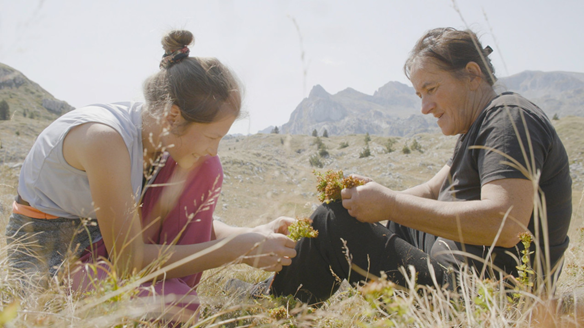
It is on the vast Sinjajevina massif, perched in the heights of the Balkans, in the north of Montenegro, that directors Biljana Tutorov and Petar Glomazić took their clinical look at the daily life, in its most intimate, of the shepherdess Gara and her niece Nada, whom she adopted after the death of her sister Mika, a victim of domestic violence. Screened at the opening of the 29th edition of the Montreal International Documentary Meetings (RIDM), the feature film Garder une montagne (To Hold a Mountain) is part of the cinema of reality to restore to us seven years of intimate observation between gestures of everyday pastoral life, impregnable militant commitment and the feelings of its two heroines.
In a rural life intimately linked to the territory, resistance becomes a vital act when it finds itself threatened by a military training ground project supported by NATO. It is this resistance, embodied by Gara and her pastoral community, which constitutes the common thread of this documentary. But beyond this fight with geopolitical dimensions, the film brings out, from the intimate, the defense of a heritage, a way of life and a family memory marked by domestic violence. This documentary reminds us once again that the need for heritage often appears when it is threatened. For the pastoral community of Sinjajevina, the mountain is not only a natural space, but it is a heritage, a source of subsistence and a territory to which the inhabitants are deeply attached. Preserving it therefore means protecting everything it contains, but also a way of inhabiting the world and defining oneself collectively. The question of transmission then naturally arises: what can we pass on to our children when this ancestral heritage is itself threatened with disappearing? As Nada grows up and leaves the mountain to go to school, her adoptive mother must both protect this territory and accompany the teenager towards an uncertain future.
The staging favors an approach that is both discreet and close, seeking intimacy without provoking it. This restraint also gives great power to silences and revelations. The wounds of the past gradually emerge through conversations and fragments of personal stories. Such an approach leaves it to the viewer to connect the present to the events that marked the family. The directors spent long periods of time with their protagonists waiting for life to unfold naturally in front of their camera. The directors’ intimate focus then focuses on the simplest gestures of pastoral life: caring for animals, milking a cow, preparing food, making cheese, carrying water or simply sharing a moment of closeness. The precision of the close-ups devoted to everyday objects and gestures contrasts with the grandiose landscapes of Sinjajevina which change with the seasons. The film establishes a striking connection with Montenegrin nature that is both austere and grandiose! It is the staging of a nature which combines the blowing of the wind, the cries of animals and, sometimes, the distant rumble of military explosions, to make the threat felt without it being necessary to explain it.
The overlap between the environmental, political and family dimensions constitutes the great strength of this documentary. By making the intimate the starting point for a reflection on violence, military threat, resistance and the defense of heritage, Tutorov and Glomazić create a deeply human documentary, where resistance is a vital political act.
Sofiane Idir

29th edition of the Montreal International Documentary Meetings RIDM November 18, 2026 1
29th edition of the Montreal International Documentary Meetings RIDM November 18, 2026 2
29th edition of the Montreal International Documentary Meetings RIDM November 18, 2026 3
29th edition of the Montreal International Documentary Meetings RIDM November 18, 2026 4
29th edition of the Montreal International Documentary Meetings RIDM November 18, 2026 5