

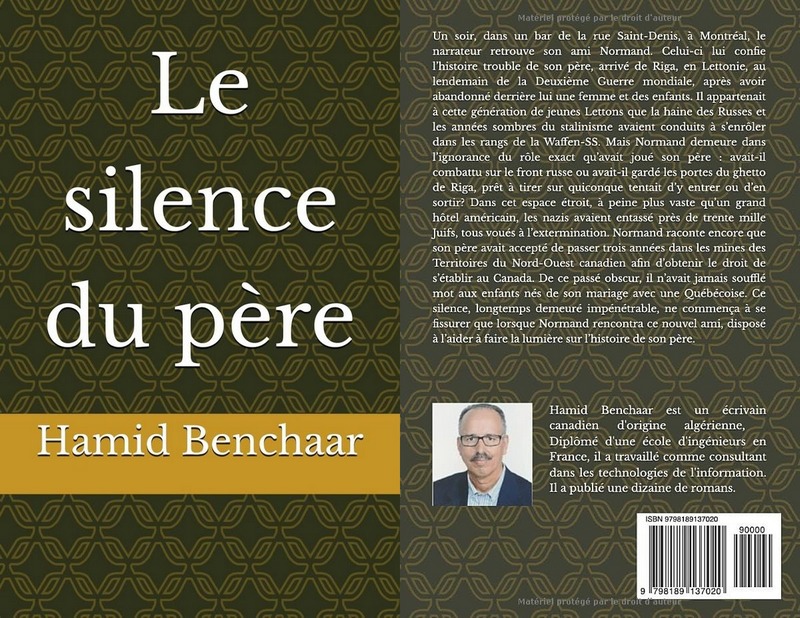
The writer Hamid Benchaar has just published his latest novel The silence of the father (2026). Originally from Algeria, he has been coming to Canada for several years where he has already published Freedom chosen and Belonging suffered: Reflections of a political and philosophical nature on exile, memory and the history of societies (2013), The child of the high plain (2014), It always begins with a dream (2015), The false dam (2017), An Algerian summer (2018), The meeting (2021).
On his Facebook page the author shares an extract from his novel:
If I stop for a momentTo talk to you about my lifeJust like that quietlyIn a bar, rue St-DenisThis story begins like in the song “The Shooting Stars” by Cowboys Fringants.A story that has lastingly changed my view of Montreal, of its anonymous crowds and of this urban peace that we spontaneously believe to be innocent. However, it begins in a banal way, one weekday evening, in a bar on rue Saint-Denis, with a colleague who was about to show me an old photograph.
Synopsis
One evening, in a bar on Saint-Denis Street, in Montreal, the narrator meets his friend Normand. He confides in him the troubled story of his father, who arrived from Riga, Latvia, after the Second World War, after leaving behind a wife and children. He belonged to that generation of young Latvians whose hatred of the Russians and the dark years of Stalinism had led to enlist in the ranks of the Waffen-SS. But Normand remains in the dark about the exact role his father played: had he fought on the Russian front or had he guarded the gates of the Riga ghetto, ready to shoot anyone who tried to enter or leave? In this narrow space, barely larger than a large American hotel, the Nazis crowded nearly thirty thousand Jews, all destined for extermination. Normand also recounts that his father had agreed to spend three years in the mines of the Canadian Northwest Territories in order to obtain the right to settle in Canada. Of this obscure past, he had never said a word to the children born from his marriage to a Quebec woman. This silence, which had long remained impenetrable, only began to crack when Normand met this new friend, willing to help him shed light on his father’s story.