


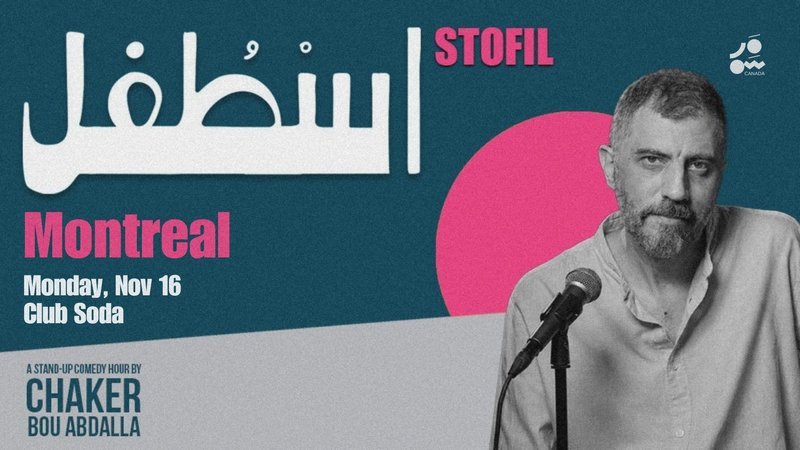
“You’re lucky the weather is nice today! « . This is how a friend greeted Lebanese comedian Chaker Bou Abdallah upon his arrival at the Montreal airport. A surprising remark to say the least, he says, when his friend is so bundled up to face the Quebec cold that only her eyes remain visible. “How can you live like this? », he says to the room, triggering a huge burst of laughter. In the audience, laughter bursts forth, spontaneous and contagious. It’s hard not to recognize yourself in this scene, familiar to anyone who has ever faced the rigors of the Montreal winter.
Behind this amusing anecdote lies a deeper reality. For the Arab communities living in Montreal, stand-up is not just a series of jokes. Through accents, popular expressions and everyday situations, humor can bring back memories, awaken emotions and recreate, during a show, this special complicity provided by a shared language and culture. Between the country we left and the city where we build our life, laughter then becomes a link, capable of bringing together two worlds that are geographically distant, but intimately linked.
Why would a Lebanese who has lived in Montreal for decades experience a particular pleasure in attending the show of a Lebanese comedian? Why would it be the same for an Egyptian, a Syrian or a Moroccan facing an artist from his country? The answer perhaps has less to do with the nationality of the comedian than with this cultural complicity which is spontaneously established between the stage and the audience. Some jokes do not need to be explained: they draw their strength from collective experiences, social habits and humorous codes that the audience immediately recognizes. This affinity does not mean that spectators remain confined to the artistic expressions of their community. They can just as easily appreciate Quebec humor or that of other cultures. However, finding an artist on stage who shares their cultural references can give them a special feeling of closeness. The show then becomes much more than entertainment: a space where cultural belonging is freely expressed, without excluding openness to others.
This complicity between the comedian and his audience finds light in the work of Maurice Halbwachs on collective memory, which shows how individual memories are constructed and reconstructed in a social framework, in close connection with the groups to which we belong. From this perspective, the comedy show can become a space where shared memories are revived: an expression heard during childhood, a typical attitude of a family character or a social situation known to all. Laughter then arises not only from the joke itself, but also from the spontaneous recognition of a common experience.
This reflection also echoes the work of Stuart Hall, for whom cultural identity does not constitute an immutable heritage that is transported intact from one country to another. It is nourished by history and memory, while transforming through contact with new experiences. In Montreal, humor can thus revive references from the country of origin while giving them a new meaning, shaped by the reality of immigration and Quebec life.
Another dimension to this reflection is brought by John W. Berry, for whom attachment to the culture of origin is not incompatible with participation in the host society. A person can preserve their cultural references, appreciate the humorous shows of their country and be equally interested in Quebec artistic productions or those of other communities. Cultural integration therefore does not imply the erasure of origins, but can be built in the coexistence of several affiliations.
In a city like Montreal, where populations with varied backgrounds and traditions meet, stand-up in Arabic can thus fulfill a dual function. It offers a moment of entertainment, while creating a space for cultural recognition. The public does not necessarily come looking for a nostalgic return to the past; he can simply experience the pleasure of laughing without translation, of catching an allusion at the first word and of sharing with others a complicity that crosses borders.
Because if the years and the kilometers transform habits, certain references remain deeply anchored in the memory. And sometimes, all it takes is an accent, an expression or an anecdote to make the country of origin seem, for a burst of laughter, much less distant.
Iman Ajine