


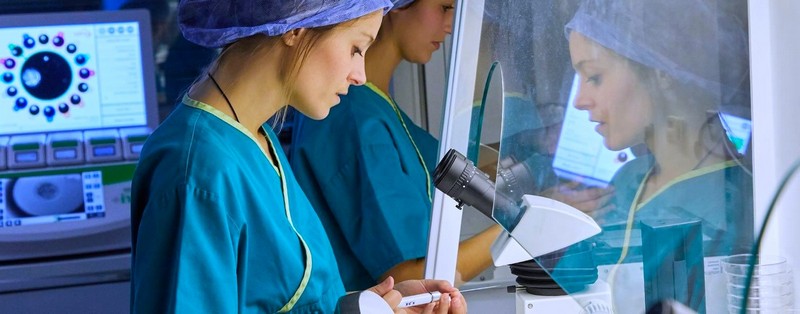
For women or men who plan to resort to medically assisted procreation (MAP) later, it is possible to preserve their gametes (oocytes or spermatozoa). These are taken or collected then preserved by freezing as part of self-preservation for non-medical reasons. Once frozen, they can be used later for PMA.
Indeed, fertility preservation has become a major priority for patients faced with medical treatments likely to affect their reproductive capacity, as well as for those wishing to delay procreation for personal or professional reasons. Advances in cryopreservation today offer effective solutions to preserve the quality and viability of oocytes, sperm, embryos and reproductive tissues, thus preserving the chances of future conception.
Self-preservation consists of freezing and preserving one’s own gametes – oocytes for women, spermatozoa for men – in order to have them available if a parental project were to require ART (Medical Assisted Reproduction) in the future. The objective is simple: preserve fertility at an age when the gametes are of good quality, to use them later if necessary.
This approach does not guarantee a future pregnancy. It constitutes a partial “insurance” – if the preserved gametes are of good quality and in sufficient number, the chances of success of subsequent IVF (in vitro fertilization) will be better than with gametes collected at a later age. But conservation does not protect against all infertility factors (uterine problems, diseases, etc.) and does not predict the outcome of an IVF attempt.
Egg freezing is gaining popularity, particularly because women tend to postpone the moment for personal and professional reasons.
Thanks to freezing, women can freeze their eggs at the age they are and preserve their fertility at this time until they want to use them.
After all, a woman’s fertility, defined as the ability to become pregnant, is never as high as between her late teens and late twenties. From the age of 30, a woman’s fertility begins to decline, and after age 35 this decline accelerates. For this reason, some specialists suggest that the ideal period to start freezing your eggs is before the age of 35.
When a woman decides to freeze her eggs, the first steps to take are a vaginal ultrasound, in order to evaluate her ovarian reserve, and to measure her hormone levels.
Throughout this month-long procedure and process, a woman may feel tired or bloated and/or have headaches or mood swings, especially for two weeks after egg retrieval.
When a woman eventually decides to use her eggs, they must be thawed and fertilized with sperm in a petri dish: this is in vitro fertilization (IVF). Three to five days after fertilization, the embryo is transferred to the woman’s uterus.
As is often the case with anything to do with fertility, it is not uncommon for people to have misconceptions about egg freezing, as some women do not realize, for example, that “egg freezing does not guarantee that you will have a baby, but that it guarantees the potential to have a baby.” They may not have realized how many steps this involves. Fortunately, thanks to the latest freezing method, vitrification, which is an ultra-rapid cooling technique preventing the formation of harmful ice crystals, oocytes have a higher survival rate than other methods.
When women decide to freeze their eggs, it is important to think about how many children to have and when they want to start trying to get pregnant. If more than one is needed, it is best to freeze at 30 years old.
However, research suggests that women who freeze their eggs before the age of 35 have the highest chance of giving birth to one. On the other hand, the older a woman is when she freezes her eggs, the lower the chances.
Unlike the slow freezing previously practiced, vitrification is an ultra-rapid cryopreservation technique that prevents the formation of intracellular ice crystals and thus protects cellular integrity. It is widely used for both oocytes and embryos and its effectiveness and safety are fully demonstrated.
In the case of oocytes, vitrification allows their conservation for long periods without alteration of their initial quality, provided that storage is maintained in optimal laboratory conditions.
However, it is important to note that oocyte quality directly depends on the age of the woman at the time of cryopreservation. It is therefore generally recommended to carry out this procedure before the age of 35, as younger eggs have a higher probability of resulting in pregnancy.
And the sperm?
Sperm cryopreservation also allows for long-term storage. As with eggs, the quality of the sperm at the time of freezing is decisive for future results.
It is essential to emphasize that vitrification is today a common and highly secure procedure. No significant difference was observed between children born from frozen gametes or embryos and those from fresh material.
Maternal age at the time of pregnancy, however, remains a determining factor: the older the patient, the more the obstetric risks – such as spontaneous miscarriage or pregnancy complications – increase, independently of the age of the gametes or embryos at the time of their planned collection for fertilization, or as part of a donation.
Potential risks to the baby or pregnancy
It is essential to emphasize that vitrification is today a common and highly secure procedure. No significant difference was observed between children born from frozen gametes or embryos and those from fresh material.
Maternal age at the time of pregnancy, however, remains a determining factor: the older the patient, the more the obstetric risks – such as spontaneous miscarriage or pregnancy complications – increase, independently of the age of the gametes or embryos at the time of their collection.
Mohand Lyazid Chibout (Iris)