

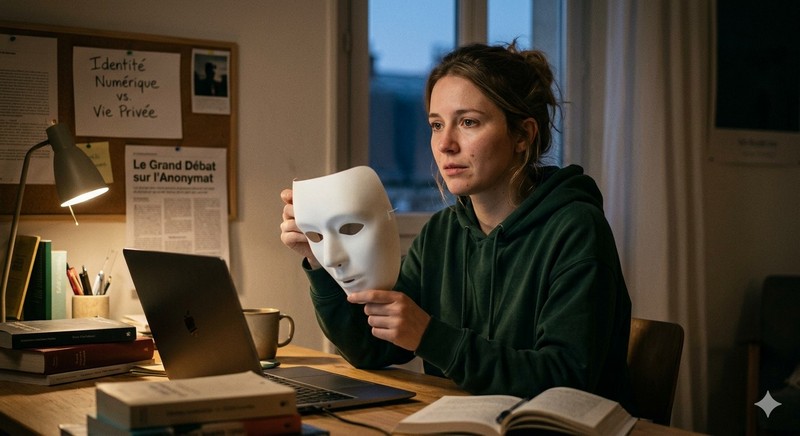
Every day, millions of murderous phrases, destructive rumors and smear campaigns flood our screens. Behind these attacks, a common point: obscure pseudonyms, synthetic avatars and the exhilarating feeling of total impunity. Faced with this violence that has become commonplace, public opinion is growing impatient and a question strongly arises: should we tear off the digital mask and ban anonymity on the Internet to clean up public debate? This debate, far from being purely technical, crystallizes a major philosophical divide on the very nature of our freedoms.
The camp of responsibility: the Internet is not a lawless zone
For supporters of strict regulation, pseudonymity has become the shield of cowards. In the physical world, insulting a passerby in the street or harassing a colleague exposes you to immediate sanctions. Why would it be any different in the virtual world? Anonymity breaks down the barriers of social inhibition: hidden behind a screen, the individual frees himself from the rules of civility.
Lifting anonymity is not censorship, it is accountability. If every comment were associated with a real identity, the fear of social reputation and legal sanctions would instantly moderate the tone of the exchanges. Furthermore, for law enforcement and justice, compulsory identification would put an end to the current obstacle course. Endless requisitions from American or Asian platforms, which often drag their feet in delivering IP addresses, would no longer be anything but a bad memory. For victims of cyberharassment, this would be a guarantee of rapid and effective justice.
The freedom camp: The pseudonym as a democratic bulwark
However, for defenders of digital freedoms, removing the right to pseudonyms is a remedy much more dangerous than the disease it claims to cure. First, because absolute anonymity on the Internet is a myth: justice already has the technical tools to identify the IP address of a cybercriminal. The real problem lies in the lack of resources of the courts, not in the absence of faces.
Then, requiring an identity document to post a message would open the door to totalitarian excesses. Pseudonymity is the last refuge of whistleblowers, investigative journalists, but also minorities and vulnerable people in hostile environments, who need to express themselves without risking being ostracized or persecuted in their real lives.
Finally, entrusting our official identity documents to tech giants or centralized platforms poses a colossal security risk. In the age of massive cyberattacks, widespread hacking of these databases would hand over the private lives of millions of citizens to cybercriminals or foreign intelligence services.
A choice of technological company
The debate on online anonymity cannot be reduced to a simple trade-off between security and freedom. It asks a fundamental question: what model of digital society do we want to leave to future generations? Will we choose an Internet of surveillance and forced authenticity, modeled on the Chinese social credit model, or will we preserve the original spirit of the Web, a space of absolute freedom, even if it means having to manage its darkest excesses?
The solution perhaps lies in a middle path: not banning the pseudonym to the general public, but forcing platforms to verify the identity of users in the background, in an encrypted manner, so that justice can act only in the event of a serious offense. One thing is certain: the status quo is no longer tenable.
Martine Dallaire, B.B.A.