


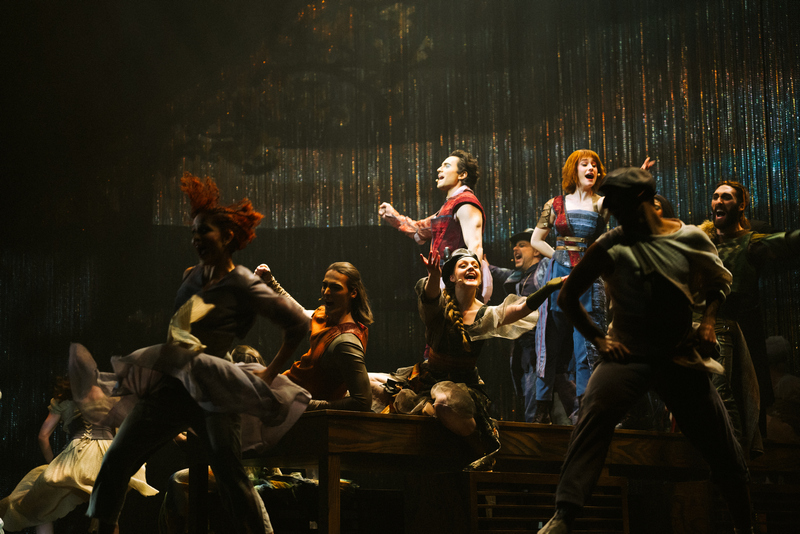
Evangeline – Credit: Sam Billington
Almost 180 years after the publication of Henry Wadsworth Longfellow’s famous poem, Evangeline, A Tale of Acadie, the French-Canadian myth is reborn in the form of a musical comedy that revisits one of the greatest stories in Acadian history. Presented in several cities in Quebec, the show, combining theater, music and dance, is scheduled this summer at the Salle Wilfrid-Pelletier at Place des Arts, from July 30 to August 9. This is a contemporary reading of this epic poem of 1400 verses to reveal the tragic story of Évangéline Bellefontaine, engaged to her lover Gabriel Lajeunesse, separated during the Deportation of the Acadians (Grand-Pré in Nova Scotia) in 1755.
The staging closely follows the verses of the poem: life in Grand-Pré, the Deportation and the exile, the wanderings and the pursuit, and finally, the reunion. From the first scenes, the viewer is captivated by the peaceful atmosphere of the village of Grand-Pré, where the ravishing Evangéline is courted by Gabriel and Baptiste, before the Deportation of the Acadians comes to upset the destiny of the characters and shatter their dreams. In this production carried by the Quebec company Gestev, director Jean Jacques Pillet offers a feminist approach, centered on the figure of Évangéline, brilliantly played by Maude Cyr-Deschênes, who amazed the gallery with her vocal performances and her beautiful stage presence. An approach which highlights the strength and resilience of women in the face of life’s ups and downs, by presenting Evangéline as a courageous, ambitious and emancipated woman like the song she performed at the start of the show (Let me be).
The staging also gives an important place to the Mi’kmaq nation, recalling the decisive role it played with the Acadians during the Deportation. The show highlights the bonds of solidarity and alliance that united the two peoples in the face of the British authorities, thus providing essential insight into an often overlooked page of Acadian history. Here again, the director chooses a female figure to embody this shared memory through the character of Hanoah, interpreted with great sensitivity by Océane Kitura.
The soundtrack of this comedy is a great success! By offering a resolutely contemporary musical universe, composer Steve Marin and arranger Yvan Cassar have taken a daring gamble, that of accompanying a historical story from the 18th century with modern musical writing. The risk of a gap between form and content might seem real, but this artistic choice proves convincing. Indeed, the 22 original songs of this musical fresco integrate perfectly into the narrative and accompany the performance of the cast without breaking the historical illusion. Véronique Giasson’s choreographies also borrow the language of contemporary dance. Far from weakening the story, they enhance the dramatic intensity by delicately translating the impulses of love, exile, resistance and hope that run through this historical fresco.
The scenography stands out for its ingenuity and its ability to serve the story without overloading it. Designed from modular blocks, the decor soberly recreates the world of Grand-Pré described in Longfellow’s poem, offering a dynamic and versatile stage space. This choice allows for fluid transitions between the different paintings (Acadian village, scenes of the Deportation and journeys). Digital projections, broadcast on moving ball sails, as well as light effects, enrich the visual experience by giving depth to the scenic scenes.
In addition to her artistic prowess, Évangéline succeeds in combining a duty of memory and a moving show, acclaimed by the Montreal public. By revisiting one of the founding stories of Acadian history through a resolutely contemporary staging, this musical comedy deals with universal and current themes, such as love, exile, resistance and attachment to the native land.
Sofiane Idir
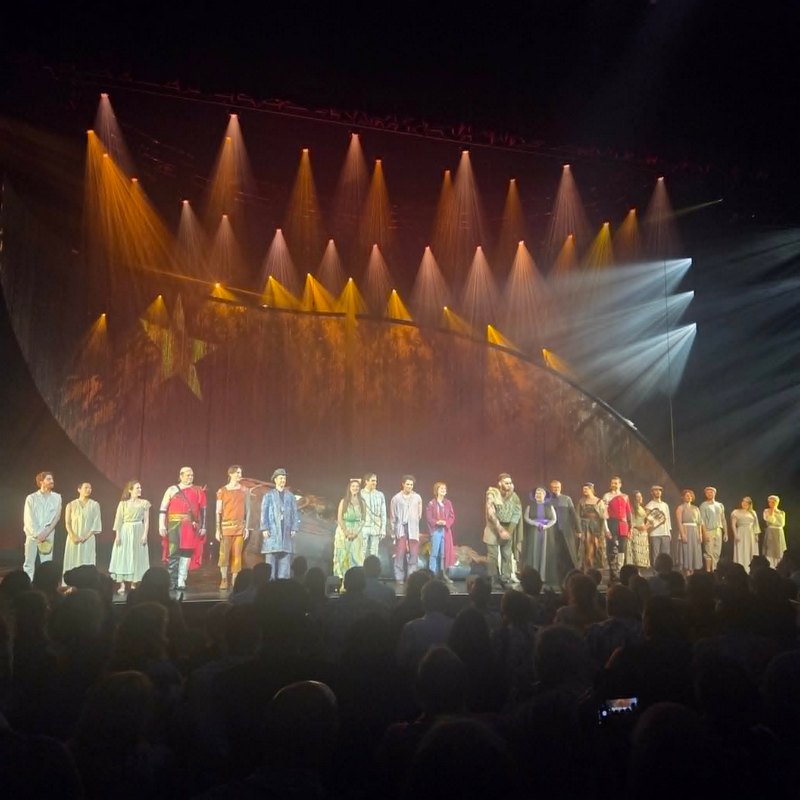
Evangeline – Credit: Sofiane Idir