



Théo Hellermann at the 55th Festival du Nouveau Cinéma 2026
Both intense and disconcerting, the first feature film by young French director Théo Hellermann, presented as a world premiere at the 55th edition of the Festival du nouveau cinéma (FNC), keeps us in suspense for the duration of a bustling class. Undermined by harassment and intimidation, a class on the verge of implosion becomes the place to examine the fractures in our world.
A chaotic class, students calling out to each other, discussions that degenerate and a teacher who is struggling to regain control. It is in this electric climate that a history teacher at the Duclaux high school in Aurillac manages to slowly re-establish his class to engage his students in a debate on democracy. This is when this fiction, inspired by personal experience, becomes interesting. A class which reflects, which debates, even which institutes, although it is always with violence! The heated discussion gradually broadens to questions that go far beyond the walls of the school: freedom of expression, class struggle, capitalism, power, inequalities, the North-South relationship, social networks and, above all, the very need to debate. The natural play of the protagonists brings out a striking paradox. While students struggle to respect and get along with each other, they are invited to think about the foundations of living together. The debate then goes beyond a simple academic exercise to become an attempt to renew dialogue in a hyperconnected, but paradoxically isolated, world!
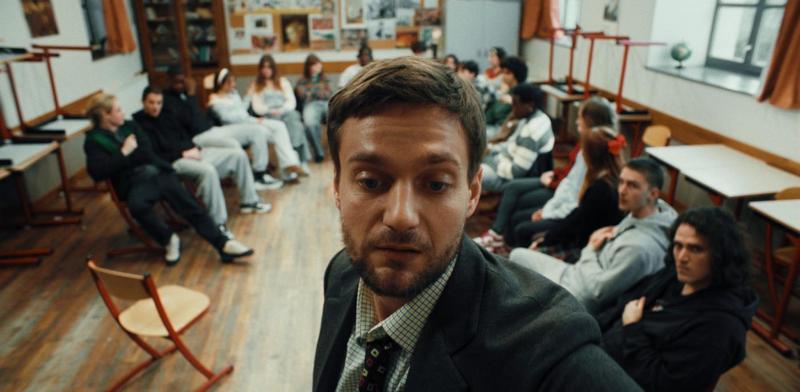
The class imagined by Hellermann looks like a miniature of our world riddled with inequalities and indifference. As the director emphasized during the discussion with the public after the screening, violence does not appear out of nowhere: it is rooted in contempt, exclusion and the refusal to recognize the other. When an individual is constantly denied, trampled on or deprived of the opportunity to be heard, violence can become, in their eyes, a final means of existence. The film explores this mechanism without justifying the act. Rather, it invites us to question the factors that lead to escalation, as well as the responsibility of those who watch without intervening. This reflection takes on a moving dimension in this social thriller through Gabriel, a high school student in his final year, victim of harassment and intimidation. Through dreamlike sequences, imbued with fantasy, the film gives us access to his inner world, his thoughts and his torments to grasp his suffering which those around him seem to deliberately ignore. Such a process gives the story a disturbing authenticity and a particular emotional depth, especially since the filmmaker, through the character of Gabriel, revisits his personal experience, he tells us, which gives his work a cathartic dimension.
The distribution gives depth to this impression of truth. In addition to Théo Hellermann, who lends his features to Gabriel, Fred Testot brilliantly plays the history teacher, while Lucas Englander, Noham Edje, Gina Jimenez, Myriam Djeljeli and Pierre Gommé masterfully bring to life a bustling school universe.
The strength of the film also lies in its staging, which aptly exploits the codes of cinema behind closed doors. The acting, natural and almost raw, gives the impression that the camera is capturing a class left to itself, without artifice or alteration. The dialogues flow, the tensions are exacerbated and the jerky rhythm, supported by the multiplication of viewing angles, intensely reproduces the brutality of the exchanges.
By tackling school bullying and exclusion, Théo Hellermann’s first feature film resonates with the high school crisis that is shaking France. The film does not claim to summarize a complex crisis, but it sheds light on an essential dimension. Exclusion and inequalities can fuel violence when a society stops looking at those it marginalizes!
Sofiane Idir