


Algerian writer Jamila Rahal will be present in Montreal during a literary meeting to be held on Friday, September 25 at 5 p.m. at the Côte des Neiges Community Resource Center – 6767, Côte des Neiges.
Books only fully exist when they leave the hands of the authors to meet their readers. So, I hope that my stay among you will be the occasion for these precious exchanges which extend the writing and give it its full meaning. Jamila Rahal
Jamila Rahal’s journey is part of a long partnership with books in publishing, children’s literature and cultural mediation. So many paths taken with the deep conviction that literature is above all a place of dialogue and that books do not just tell the story of the world, they participate in its transformation.
At the heart of the dark decade, in the mid-1990s, she co-founded the association Le Petit Lecteur. For some, her commitment was out of step in the face of the violence that was tearing the country apart and pushing it into one of its darkest periods: “we, who were essentially women and mothers, were firmly convinced that cultivating critical thinking, offering children the weapons of thought to resist fundamentalist and fundamentalist influence, was an equally vital emergency, another way of resisting.”
Now, Jamila Rahal devotes her retirement to writing. She writes in French, in a linguistic landscape where the relationship with language is increasingly sensitive. His novels are in a historical and realistic vein which allows him to explore reality, while shedding light on blind spots and gray areas. The place of women is always central.
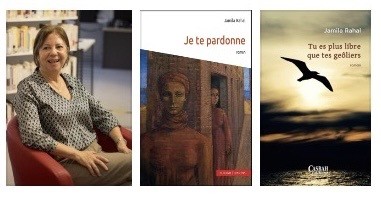
In You are freer than your jailers, it traces the thread of more than half a century of Algerian history preceding the insurrection of November 1, 1954, a founding period too often overlooked, distorted or simplified.
In I Pardon You, she gives voice to a contemporary Algerian woman, in search of meaning and survival, grappling with patriarchal brutality, the complexity of family dynamics and the still vivid trauma of the dark decade.
Her common thread, according to her, is always the same: “tracking down gray areas, questioning silences, making heard the voices that we suppress and making visible what taboos erase from our collective memory or, at least, prefer to leave in the shadows”.