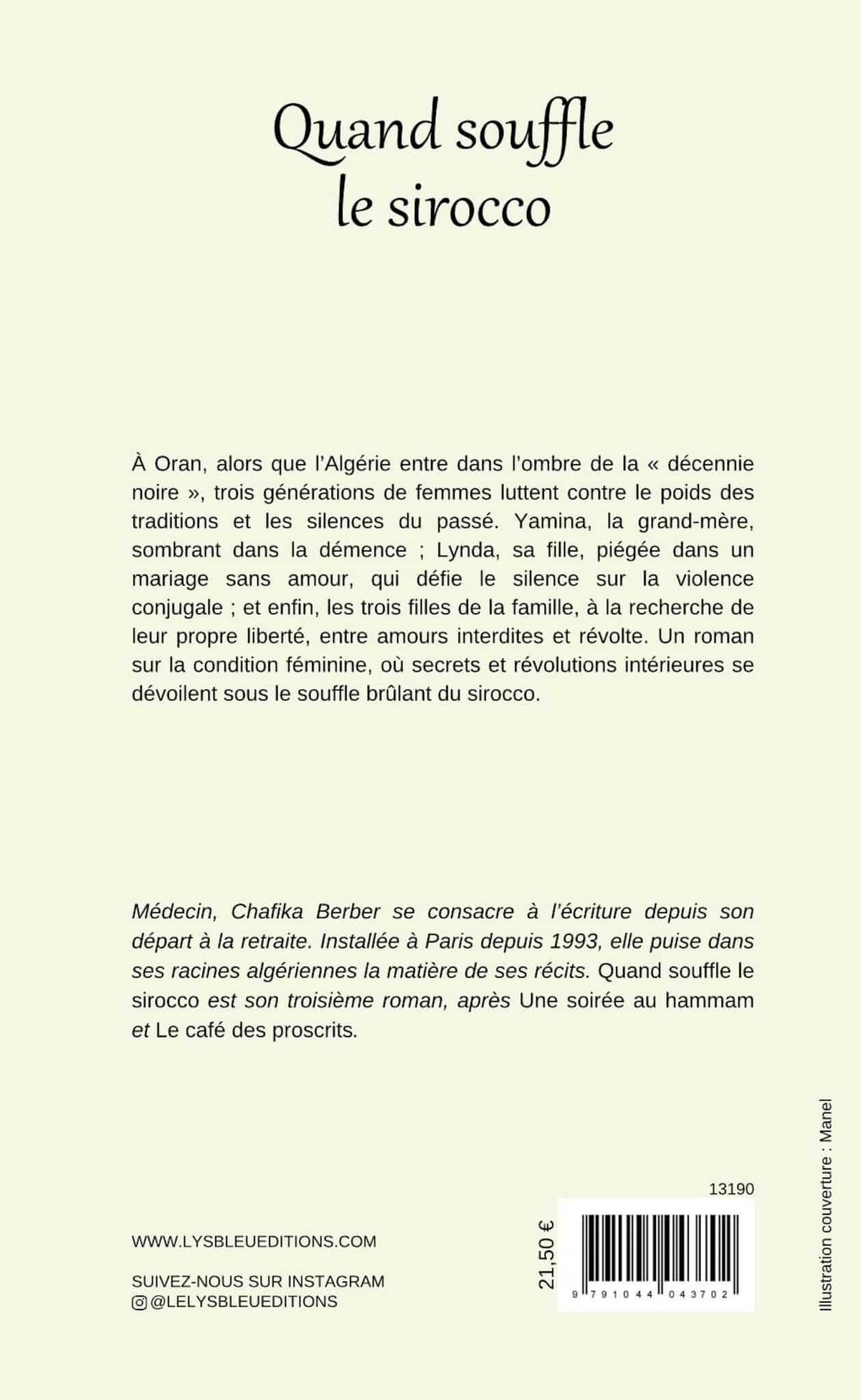


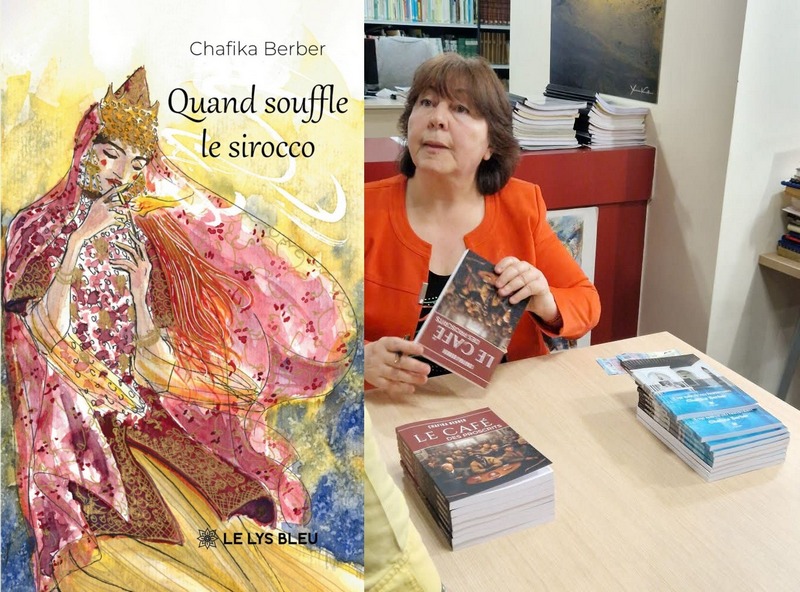
A specialist in physical medicine and rehabilitation for more than thirty years, Chafika Berber is retiring and devoting herself fully to writing. After publishing Une soir au hammam (2021) and Le café des procrits (2024), she is working on a new novel When blows the sirocco (2026). It highlights three generations of women who sometimes get along, and other times blame each other. They find themselves in situations where ideas become entangled to leave room for numerous questions.
The initiative: The title “When the sirocco blows” makes us think of a storm that devastates everything in its path. Only in the novel, we witness a hope to marry or to be married. This blowing wind brings the suitors. Can you explain this poetic image?
Chafika Berber: The sirocco, this violent and hot wind that comes to us from the Sahara really opens this novel. It appeared naturally when I started writing this story, above all like a powerful breath that awakens a deeply sleeping city. Beyond this poetic image, he is a real character who establishes himself loudly over several chapters. We quickly guess that the simple mention of marriage does not sum up this novel, because we gradually discover women in turmoil. The bursts underlie the intimate scenes, the unsaid, also isolate a family which wants to be blind and deaf to the horrors experienced by an entire people during the dark decade. A storm that aims to be the echo of cries and tears that I am unable to describe because the pain is so great. And this character with many faces will be deciphered by everyone, as they feel, as they wish. Sand red like the blood of the victims, infernal legions which rumble in the streets of a violent city, listening to bruised hearts, conscious or unconscious protector of souls in pain…
Reading the novel, we detect some thought-provoking sentences, such as: ‘If only Lynda had had a son, a house without a man was the prey of all lusts’.
» Were you happy Yemma? Yamina looks at her daughter for a long time, and responds thoughtfully. Happy ? I don’t know my daughter. I didn’t go to school, and I don’t know the meaning of words. »
Can you explain the context of these two situations?
A mother and her three daughters. An almost universal story, perhaps not in the same continuum, where the son is the foundation of a home. “Three girls are as good as one boy,” Lynda replies. Unfortunately, the laws do not see it that way and inheritance is a clear illustration of this. The dark decade only reinforces the fragility of a woman left to the wolves.
» Happy » ? The evocation of happiness is constant and accompanies each generation with a definition that changes over time. Yamina, the grandmother, wise and illiterate, does not know the definition. Lynda, her daughter, somehow sums it up with unfulfilled expectations and desires. As for the three girls, will they be able to redefine happiness in accomplishment, no longer wishful thinking but voluntary action and insubordination?
What was your focus in bringing three different generations into dialogue?
It is indeed a real dialogue that takes place between these three generations of women, with its silences, its bites and its fears, its confidences and its tears. Like a closed room which initially reveals the absurd “special day”. Three generations which come together, come together, fall apart, and reveal an evolution of morals through the sacred bonds of marriage. We remember the august hymen and its ceremonial, domestic violence, offensive love…
The man is seen through the woman’s gaze. Is this a choice to give more importance to the woman’s words or for another reason that deserves to be explained?
Men exist without the gaze of women…however necessary. By reading this novel, we will discover a multiple woman’s perspective. The look is not enough because the body is preponderant in this modest gallery of female characters. However, it expresses many emotions, from anger, incomprehension, indulgence, pain to the deepest love.
I did not deliberately choose the female gaze to define a male character. It has established itself as a rather talkative mirror which observes a fading body, a spurned lover, an invisible suitor, a sinister stranger, and ultimately it is in the gaze of a man that a woman finds her answers.
Comments collected by Lamia Bereksi Meddahi
 .
.