


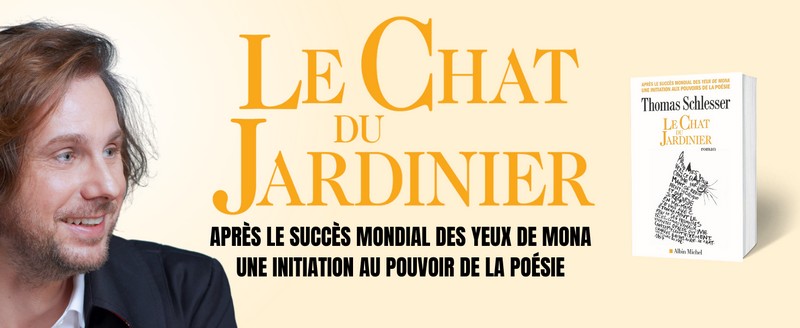
After the worldwide success of Mona’s Eyes, which sold more than a million copies, Thomas Shlesser invites the reader to explore the world of poets in The Gardener’s Cat[1]. Director of the Hartung-Bergman Foundation and professor of art history at the École Polytechnique, he won the “Author of the Year” prize and was elected “Book of the year” in the United States by Barnes & Noble in 2025.
Words to the rescue of evils
Louis, who turns out to be an extremely sensitive gardener, is unable to bounce back from the storm which has just ravaged the Provençal hinterland: “The whole countryside prayed in secret for an end to this senseless frenzy of the air and the rain which, under the influence of the gusts, fell obliquely. And it was neither the spears of the mistral nor the familiar rages of storms or lightning, so frequent on the Mediterranean coasts, which that evening made the shutters slam and the children jump, but a tumult of unknown, almost supernatural violence. » (P. 12)
What makes the gardener special is his cat. He is with him all the time. Unnamed, this pet represents everything a human being needs: affection, attention and even care when illness reveals itself. In this close bond between the gardener and the cat appears Thalie, a recently retired French teacher. The exchange between them takes place straight away. On the one hand, he takes care of his domain and on the other hand she tickles his sensibilities through poetry. This world of words where details count is crossed by poets who have left their mark on History. Indeed, Louise Ackermann, Guillaume Apollinaire Louis Aragon, Antonin Artaud, Thérèse d’Avila, Brbara, Charles Baudelaire, William Blake, Alexandre Blok, Nicolas Boileau, Jorge Luis Borges, Georges Brassens, Jacques Brel, Emily Brontê, Michel-Ange Buonarroti, Aimé Césaire, Réné Char, Danté, Marceline Desbordes-Valmore, Robert Denos, Emily Dickinson, Birago Diop, T.S Eliot, Paul Eluard, Léo Ferré, Serge Gainsbourg, Federico Garcia Lorca, Johann Wolfgang Von Goethe, William Ernest Henley, José Maria de Heredia, Friedrich Holderlin, Homer, Victor Hugo, Rudyard Kipling, Ivan Andreevitch Krylov, Louise Labé, Jean de la Fontaine, Alphonse de Lamartine, Nicolaus Lenau, Giacomo Leopardi, Vladimir Mayakovsky, François de Malherbe, Stéphane Mqllqrmé, Ossip Mandelstam, Marie de France, Filippo Tommasso Marinetti, John Milton, Pablo Neruda, Gérard de Nerval, Anna de Noailles, Ovide, Cesare Pavese, Fernando Pessoa, Edgard Allan Poe, Alexandre Pushkine, Jacques Prévert, Marcel Proust Raymond Queneau, Rainer Maria Rilke, Arthur Rimbaud, Maurice Rollinat, Pierre de Ronsard, Jacques Roubaud, Claude Roy, Sappho, Léopold Sédar Senghor, Gaspara Stampa, Anna Sylvestre, Torquato Tasso, Georg Trakl, Marina Tsvetaîeva, Jacint Verdaguer, Paul Verlaine, François Villon, Virgil, Roger Waters, Phillis Wheatley, Walt Whitman, Mary Wroth, are cited to explain to the gardener that if the human being does not take no time to become aware of what surrounds him he cannot in any way give meaning to his life. It is thanks to poetry that everyday life is not a simple repetition of gestures but a cadence, a movement which seeks a symphony to ensure rhythm.
The Gardener’s Cat, a novel formulated in the image of a course given to students, recalls all those who have left their mark on History. By taking Thalie and Louis as the main characters, Thomas Shlesser succeeds in healing the wounds of a reader likely to be in a state of suffering. The cat, an animal that cannot pronounce words, is taken into a state where it is monitored by a veterinarian. The serious illness is confirmed and Louis finds himself distraught. The author, through his skill, manages to make feelings waltz, often in continual change.
Thomas Shlesser does not just narrate but arouses the curiosity of the reader to explore what is hidden behind all the poems that were written in the past.
Lamia Bereksi Meddahi
[1] Thomas Shlesser. The gardener’s cat. Ed/Albin Michel. 2026. 381 pages